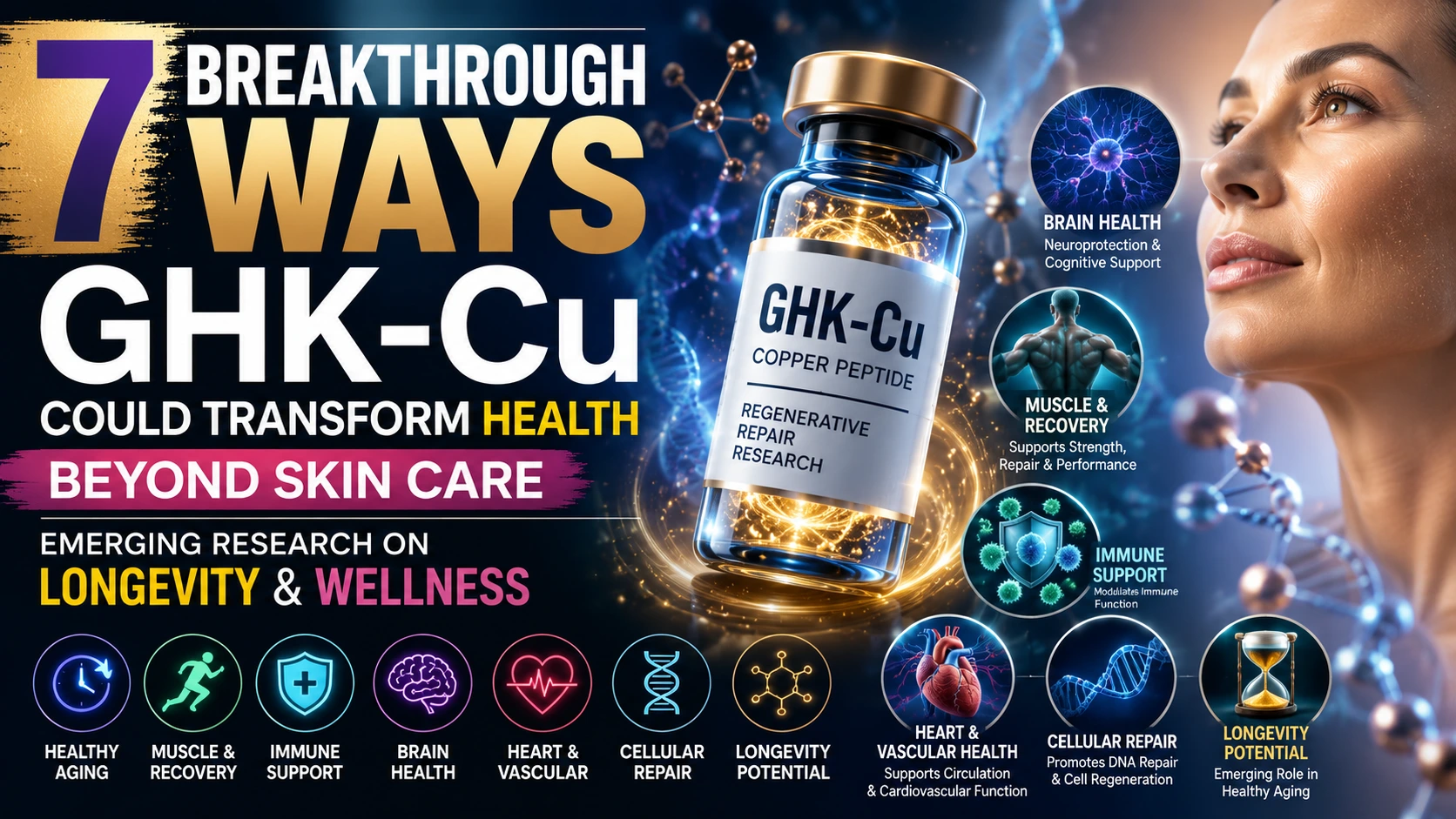

From anti-aging serums to systemic healing — the copper peptide GHK-Cu is stepping into the spotlight with promising research in inflammation, wound repair, neuroprotection, and tissue regeneration.
📖 What’s Inside
🔬 Introduction: Beyond the Cosmetic Counter
GHK-Cu (glycyl-L-histidyl-L-lysine copper complex) has long been a darling of the cosmetic industry, celebrated for its ability to stimulate collagen, elastin, and glycosaminoglycans in the skin [1]. But a growing body of research suggests its therapeutic potential extends far beyond reducing fine lines and wrinkles. From systemic anti-inflammatory effects to neuroprotection and bone regeneration, GHK-Cu is emerging as a multifaceted molecule with applications that could redefine its role in medicine.
This article explores how GHK-Cu research is expanding into new frontiers, supported by recent preclinical and early human studies, and what this means for the future of peptide-based therapies.
🚀 Ready to Explore GHK-Cu for Yourself?
Don’t wait for the future — start your tissue-repair journey today!
Whether you’re interested in topical support or systemic protocols, GHK-Cu is gaining traction among health enthusiasts. Take the next step with trusted solutions.
👉 CLAIM YOUR EXCLUSIVE OFFER 👈⚙️ How GHK-Cu Works: A Systems-Level View
GHK-Cu is a naturally occurring tripeptide first isolated from human plasma in 1973 [2]. Its biological activity is driven by its ability to modulate gene expression — research has shown it can influence thousands of human genes, upregulating those involved in antioxidant defense, tissue repair, and anti-inflammatory pathways while downregulating genes associated with inflammation and tissue destruction [3].
Key mechanisms include:
- Anti-inflammatory & antioxidant effects: Recent research in zebrafish models demonstrated that GHK-Cu significantly reduces pro-inflammatory cytokines (TNF-α, IL-1β, IL-6) and increases anti-inflammatory IL-10, while also lowering oxidative stress markers like nitric oxide (NO) and reactive oxygen species (ROS) [1].
- Collagen and ECM stimulation: GHK-Cu promotes synthesis of collagen I, III, and IV, elastin, and glycosaminoglycans, essential for tissue integrity [2].
- Angiogenesis and wound healing: It stimulates new blood vessel formation and accelerates wound closure, with human studies showing up to 3× faster healing in diabetic ulcers [4].
- Neuroprotective potential: Animal studies suggest intranasal GHK-Cu may reduce amyloid plaques, lower neuroinflammation, and delay cognitive decline in Alzheimer’s models [4].
🧬 Emerging Applications Beyond Cosmetics
1. Anti-Inflammatory & Antioxidant Therapy
A 2026 study published in European Journal of Pharmacology confirmed that GHK-Cu exerts significant anti-inflammatory and antioxidant effects in zebrafish models, potentially via the JAK1-STAT3 pathway [1]. This opens doors for applications in chronic inflammatory conditions, dermatological disorders, and even lung fibrosis.
2. Wound Healing & Tissue Repair
Human trials have demonstrated that topical GHK-Cu accelerates wound closure in diabetic ulcers and venous stasis ulcers, with a significantly lower rate of infection [4]. Emerging injectable formulations, such as GHK-Cu-loaded hydroxyapatite microspheres, show sustained release over 7 days, reducing injection frequency while promoting collagen deposition and reducing inflammation [5].
3. Bone Regeneration & Osteogenesis
Conjugates of GHK-Cu with hyaluronic acid have demonstrated osteogenic and angiogenic synergistic effects, promoting the expression of bone morphogenetic protein-2 (BMP-2) and vascular endothelial growth factor (VEGF) [6]. This suggests potential applications in bone healing and orthopedic regeneration.
4. Neuroprotection & Cognitive Health
Preclinical studies in mice show that intranasal GHK-Cu (15 mg/kg) enhances spatial memory, reduces neuroinflammation, and decreases axonal damage [4]. In Alzheimer’s models, GHK-Cu reduced amyloid plaques and delayed cognitive decline, though human trials are needed to confirm these findings.
5. Hair Growth Stimulation
GHK-Cu has shown efficacy comparable to 5% minoxidil in stimulating hair growth, likely by improving scalp vascularity, prolonging the anagen phase, and reducing TGF-β1 overexpression associated with hereditary hair loss [3].
📊 Comparative Overview: GHK-Cu Applications
| Application Area | Evidence Level | Key Findings | Clinical Status |
|---|---|---|---|
| Skin Aging / Wrinkles | Human RCTs | Increased skin density, reduced fine lines; outperformed vitamin C & retinoic acid in collagen production [3] | ✅ Widely used in cosmetics |
| Wound Healing (Diabetic Ulcers) | Human trials | 3× faster closure vs. placebo; lower infection rates [4] | 🔬 Investigational |
| Anti-Inflammatory / Antioxidant | Preclinical (zebrafish) | Reduced TNF-α, IL-1β, IL-6; increased IL-10; modulated JAK1 pathway [1] | 🧪 Research phase |
| Bone Regeneration | In vitro / animal | Promoted BMP-2, VEGF expression; osteogenic synergy with hyaluronic acid [6] | 🧪 Preclinical |
| Neuroprotection (Alzheimer’s) | Animal models | Reduced amyloid plaques, delayed cognitive decline, lowered neuroinflammation [4] | 🧪 Early preclinical |
| Hair Growth | Limited human | Comparable to minoxidil; increased follicle size and anagen phase [3] | 🔬 Emerging |
💎 Unlock the Full Potential of GHK-Cu
While research evolves, YOU can access premium-grade peptide solutions today.
Join thousands who are exploring next-gen tissue repair and metabolic health. Don’t miss your chance to experience the difference.
🔥 GRAB YOUR SPOT — EXCLUSIVE DEAL 🔥❓ Frequently Asked Questions
🌟 Your Journey to Regeneration Starts Here
From research to reality — access the tools that forward-thinking individuals are using.
Whether you’re looking for topical support or systemic protocols, GHK-Cu is changing the way we approach repair and rejuvenation.
👉 DISCOVER YOUR OPTION NOW 👈References:
[1] Hu, J. et al. (2026). Glycyl-L-histidyl-L-lysine-Cu2+ (GHK-Cu) Attenuates CuSO4 or LPS-induced inflammation in Zebrafish larvae model. European Journal of Pharmacology. Link
[2] Pickart, L. (1973). Isolation of a tripeptide from human serum that enhances the growth of hepatoma cells. Biochemical and Biophysical Research Communications.
[3] AMD Alliance. (2026). GHK-Cu Peptide: Evidence-Based Benefits, Mechanisms, Dosage, and Safety. Link
[4] Fagron Academy. (2026). GHK-Cu: Beyond Cosmetic Hype. Link
[5] Qiu, T. et al. (2025). Injectable hydroxyapatite microsphere filler loaded with GHK-Cu tripeptide for anti-inflammatory and antioxidant effects. Colloids and Surfaces B: Biointerfaces. Link
[6] G. et al. (2025). Copper Complexes with GHK–Hyaluronan Conjugates Show Antioxidant Properties and Osteogenic and Angiogenic Synergistic Effects. Bioconjugate Chemistry. Link
[7] Harmony Health Solutions. (2026). GHK-Cu Copper Peptide: Professional Protocol. Link