
How digital tools, behavioral cues, and structured support can help patients stay the course — and why persistence matters more than perfection.
🚀 Discover Lotessa →📑 Table of Contents
The Discontinuation Crisis: A Reality Check
GLP‑1 receptor agonists like semaglutide and tirzepatide have transformed obesity treatment, delivering weight losses that were unimaginable a decade ago. Yet a troubling pattern has emerged: most patients stop taking these medications within a year.
A landmark cohort study of over 125,000 patients found that 64.8% of patients without type 2 diabetes discontinued their GLP‑1 medication within one year. Even among those with type 2 diabetes, the discontinuation rate was nearly 47%.
The implications are serious. Clinical trials have clearly shown that these medications must be continued for sustained effects. When patients stop, they typically regain weight — an average of ~0.4 kg per month, with projections suggesting a return to baseline weight within 1.5–2 years.
Why Patients Stop: The Real Reasons Behind the Numbers
To solve the discontinuation problem, we must first understand why patients stop. Research has identified several key drivers.
Side Effects Are the Leading Reason — A cross‑sectional study found that 52% of patients who discontinued GLP‑1 therapy cited adverse effects as their primary reason, most commonly nausea, vomiting, and gastrointestinal issues. The timing is revealing: patients who stop due to side effects tend to do so early in treatment.
Cost and Access Barriers — A Cleveland Clinic study found that 47.6% of patients stopped their GLP‑1 medication for financial reasons, including insurance denial, expiration of discount coupons, or unaffordable out-of-pocket costs. Patients discontinuing due to cost were more likely to do so later in treatment.
Medication Shortages — 11.8% of patients in the Cleveland Clinic study stopped due to shortages.
Perceived Ineffectiveness — Some patients stop because they feel the medication isn’t working. Higher weight loss was significantly associated with lower rates of discontinuation — a 1% reduction in weight corresponded to a 3.1‑3.3% lower hazard of stopping.
💡 If you are thinking about stopping your medication, would you like tips on how to safely talk to your doctor about tapering off, or do you want to discuss managing side effects?
The Behavioral Solution: Reminders and Cues
If side effects, cost, and perceived ineffectiveness are the “why,” what’s the “how” of staying on track? Behavioral science offers a powerful answer: cues to action.
Cues to action are signals — visual, auditory, or situational — that prompt you to engage in a specific behavior. When placed strategically, they help automate habits and reduce the mental effort required to remember important actions.
How cues support GLP‑1 adherence:
- Consistency — Regular reminders help you stay consistent with your medication schedule.
- Automated habits — Cues can make taking your medication feel as routine as brushing your teeth.
- Reduced decision fatigue — When you don’t have to remember whether you took your dose, you have more mental energy for other choices.
Practical cue examples:
- Setting a phone alarm for your weekly injection
- Placing your medication next to your toothbrush as a visual reminder
- Associating your dose with a daily routine, like morning coffee
The Evidence from Digital Health: Tracking Changes Everything
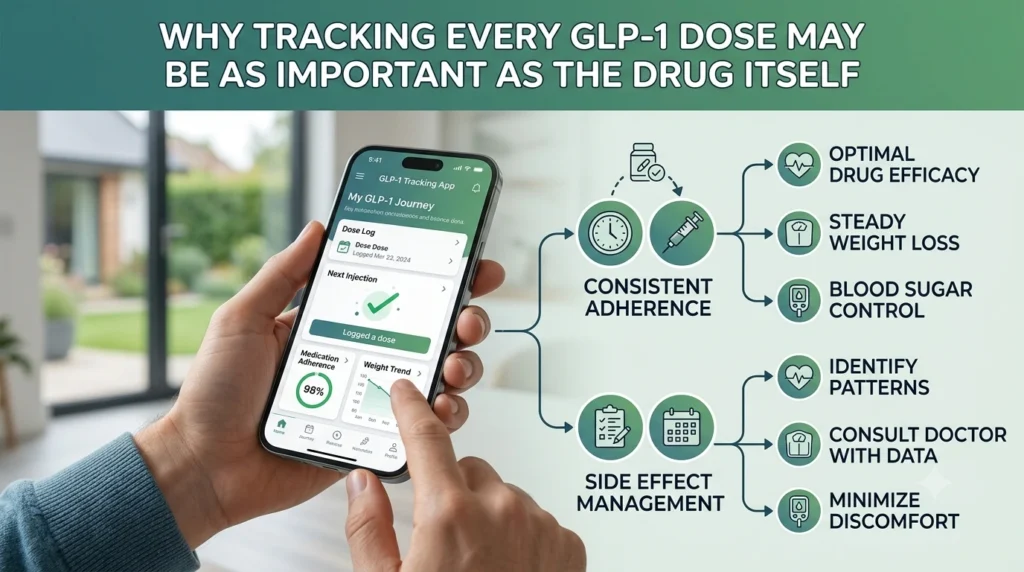
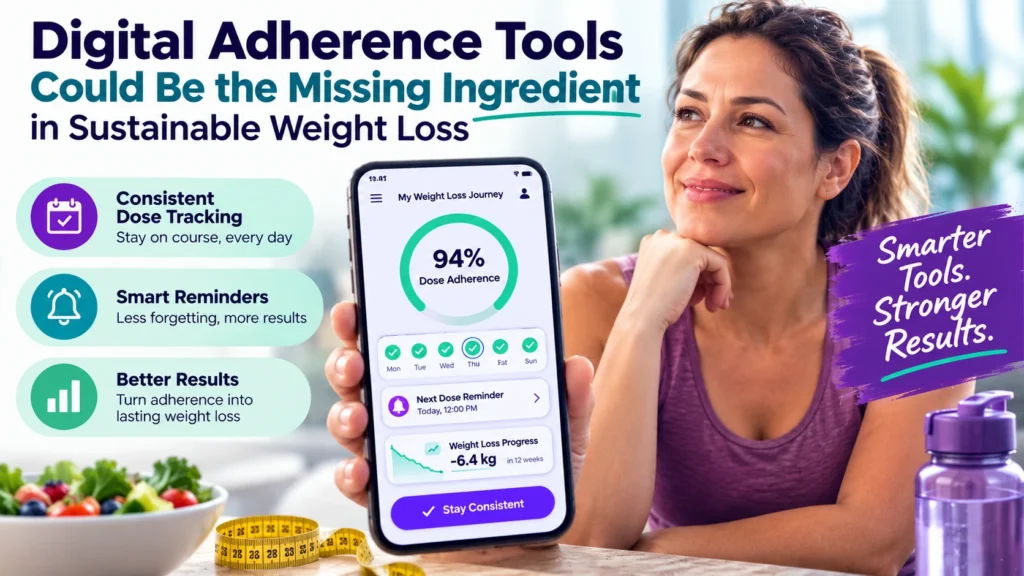
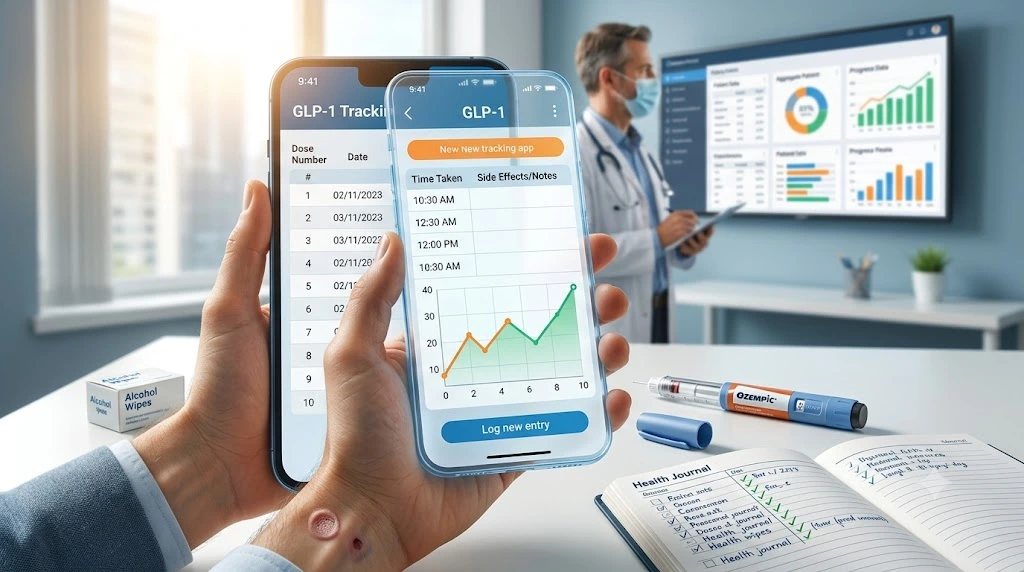
The data is compelling: digital engagement transforms GLP‑1 outcomes. A retrospective cohort study of over 19,000 patients in a UK digital weight‑loss service found that consistent weekly weight tracking and health coach communication were the strongest positive predictors of long‑term adherence and weight loss.
Key findings from the study:
- The 12‑month adherence rate was just 27% — meaning 73% of patients did not persist with the program.
- However, the adherent sub‑cohort achieved a mean weight loss of 22.60%, compared to 13.62% in the full cohort.
- Reporting side effects was positively correlated with adherence, suggesting that engaged patients are more likely to communicate openly about their experience.
Interestingly, the study also found that “hyper‑engagement” — intensive tracking frequency and rapid early weight loss — was a negative predictor of 12‑month adherence. This suggests that sustainable, moderate behavioral pacing is more effective than extreme early intensity.
Apps That Deliver: From Reminders to Full Support Systems
Smart medication reminders are evolving into comprehensive digital health ecosystems designed specifically for the GLP‑1 journey. Here are two examples that illustrate the trend.
WeTide: GLP‑1 Tracker
- Built specifically for people taking GLP‑1 medications like Ozempic, Wegovy, and Mounjaro.
- Features include shot tracking with reminders, side effect support, smart food logging via AI, and a “Journey Card” that builds a visual timeline of progress.
- Offers a medication level estimator to help users understand where they are in their treatment cycle.
Lotessa: GLP‑1 Tracker and Aftercare App
- Built by a GLP‑1 patient who experienced the aftercare gap firsthand, with UK clinical advisors and grounding in the NHS pathway.
- Features include injection and pill tracking with smart reminders, 3D body composition scanning, side effect logging, a GLP‑1 knowledge library, and a moderated community.
- Explicitly addresses the discontinuation crisis: “Over half of GLP‑1 patients discontinue within the first year. Lotessa exists to change that.”
The Future Is Digital — and Personal
The race to develop oral GLP‑1 medications is heating up, with pharmaceutical companies moving beyond injectables to daily pills. But this innovation won’t remove the complexity of weight‑management journeys.
The WHO has issued its first global guideline endorsing GLP‑1 therapies for long‑term treatment of obesity, formally recognising obesity as a chronic, relapsing disease that requires lifelong, person‑centred care with structured behavioral interventions.
A Path Forward
The discontinuation crisis in GLP‑1 therapy is real — over half of patients stop within the first year. But the solution is emerging. Smart medication reminders, backed by behavioral science and supported by comprehensive digital health platforms, have the potential to change this trajectory.
What we know:
- Patients stop for understandable reasons: side effects, cost, perceived ineffectiveness, and goal completion misunderstanding.
- Digital engagement — particularly consistent tracking and communication — is the strongest predictor of persistence.
- Apps that combine reminders, symptom logging, progress tracking, and community support can bridge the gap between prescription and lasting success.
What we need:
- Continued research to refine digital interventions
- Wider access to affordable medication
- Integration of digital support into clinical care pathways
- Better patient education about GLP‑1 as a long‑term treatment for a chronic condition
🚀 Start Your Journey with Lotessa
📱 Ready to Transform Your GLP‑1 Journey?
Don’t let missed doses or discontinuation hold you back. Join thousands of GLP‑1 users who have discovered the power of structured tracking with Lotessa.
👉 Try Lotessa Today →Your journey to sustainable weight loss starts with one click.