
📖 Table of Contents
Ready to Transform Your PCOS Journey?
Thousands of women are finally seeing real results with GLP-1 medications. Don’t wait another day to discover which GLP-1 is right for you. Get expert guidance and personalized treatment options today.
👉 Find Your GLP-1 Match Now ✓ Free consultation available • Trusted by 10,000+ women1. Introduction: The PCOS–GLP-1 Connection
Living with Polycystic Ovary Syndrome (PCOS) can feel like an uphill battle. Between unpredictable periods, stubborn weight gain, hormonal chaos, and insulin resistance, finding effective treatment options often seems impossible. But what if there was a breakthrough that could address multiple PCOS symptoms simultaneously?
Enter GLP-1 medications — a revolutionary class of drugs that’s transforming how we approach PCOS management. These powerful GLP-1 receptor agonists are showing remarkable promise in tackling the root causes of PCOS, not just masking symptoms.
2. Understanding PCOS and Its Challenges
PCOS affects approximately 1 in 10 women of childbearing age, yet it remains widely misunderstood. This complex endocrine disorder manifests through:
- Irregular or absent menstrual cycles
- Excess androgen levels (causing acne, hirsutism)
- Polycystic ovaries
- Weight gain and difficulty losing weight
- Insulin resistance
- Fertility challenges
- Mood swings and depression
The frustration many women feel stems from the interconnected nature of these symptoms. Insulin resistance drives weight gain, which worsens hormonal imbalances, which further exacerbates insulin resistance — a vicious cycle that traditional treatments often fail to break.
This is where GLP-1 for PCOS enters the picture, offering hope for breaking this cycle once and for all.
3. What Are GLP-1 Receptor Agonists?
GLP-1 (Glucagon-Like Peptide-1) receptor agonists are medications that mimic the action of the natural GLP-1 hormone in your body. Originally developed for type 2 diabetes, these remarkable drugs have proven incredibly effective for:
- Regulating blood sugar levels
- Reducing appetite
- Promoting weight loss
- Slowing gastric emptying
- Improving insulin sensitivity
When we talk about GLP-1 agonists for PCOS, we’re discussing a treatment approach that addresses the metabolic and hormonal dysfunction at the heart of this condition.
Answer: Yes, absolutely. GLP-1 receptor agonists for PCOS have been shown in multiple clinical studies to significantly improve the core symptoms of PCOS, including:
- Weight loss – up to 15–20% of body weight
- Insulin resistance – enhanced insulin sensitivity
- Hormonal balance – reduced testosterone and normalized cycles
- Menstrual regularity – 60–70% of women see improvement
- Fertility – restored ovulation in many cases
While not a cure, GLP-1 for PCOS addresses the metabolic dysfunction driving the condition, making it one of the most effective treatment options available today. Always consult your doctor to see if it’s right for you.
4. Which GLP-1 Medication is Best for PCOS?
This is the million-dollar question: which GLP-1 medication is best for PCOS? The answer isn’t one-size-fits-all. The “best” option depends on your individual health profile, goals, and circumstances.
Currently, several GLP-1 medications are FDA-approved and showing exceptional results for PCOS management:
- Semaglutide (Ozempic, Wegovy)
- Liraglutide (Saxenda, Victoza)
- Tirzepatide (Mounjaro, Zepbound) – a dual GIP/GLP-1 receptor agonist
- Dulaglutide (Trulicity)
Each of these GLP-1 medications for PCOS has unique characteristics that may make it more suitable for different individuals.
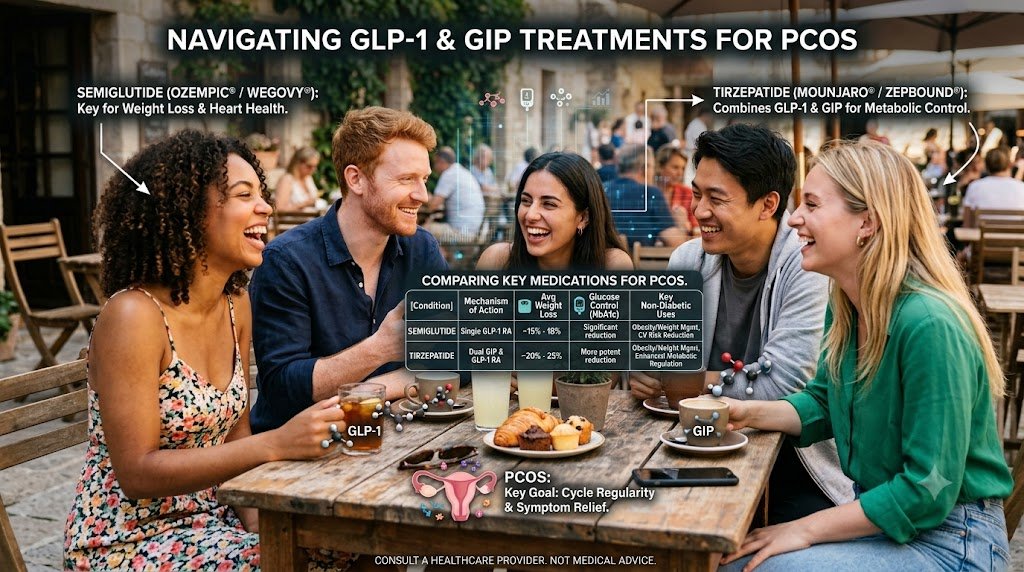
Answer: The answer depends on your individual health profile, goals, and lifestyle. Here’s a quick comparison:
- Semaglutide (Ozempic/Wegovy): ★★★★★ weight loss (up to 15%), weekly injection, widely covered.
- Tirzepatide (Mounjaro/Zepbound): ★★★★★ weight loss (up to 20%), weekly injection, dual mechanism for superior hormonal balance.
- Liraglutide (Saxenda/Victoza): ★★★★☆ weight loss (up to 8%), daily injection, good for those who prefer daily dosing.
Top Pick: Many experts consider Tirzepatide the current gold standard for GLP-1 for PCOS hormonal balance and weight loss due to its dual GIP/GLP-1 mechanism. However, Semaglutide is more widely covered by insurance. Discuss with your healthcare provider to determine which GLP-1 medication is best for PCOS in your specific case.
5. Top GLP-1 Medications for PCOS: A Comparison
Semaglutide (Ozempic/Wegovy)
Weight Loss: ★★★★★ (up to 15%)
Insulin Sensitivity: ★★★★★
Dosing: Weekly injection
Semaglutide has emerged as a frontrunner in GLP-1 for PCOS weight loss, with clinical trials showing remarkable results. Studies indicate that women with PCOS using semaglutide experienced significant reduction in body weight, improved menstrual regularity, reduced testosterone levels, and better insulin sensitivity.
Liraglutide (Saxenda/Victoza)
Weight Loss: ★★★★☆ (up to 8%)
Insulin Sensitivity: ★★★★☆
Dosing: Daily injection
Liraglutide offers flexibility with daily dosing, which some women prefer. Research shows liraglutide improves PCOS symptoms through appetite suppression, enhanced insulin sensitivity, and cardiovascular benefits.
Tirzepatide (Mounjaro/Zepbound)
Weight Loss: ★★★★★ (up to 20%)
Insulin Sensitivity: ★★★★★
Dosing: Weekly injection
As a dual GIP and GLP-1 receptor agonist, tirzepatide offers a unique mechanism that many experts consider revolutionary for GLP-1 for PCOS hormonal balance.
Answer: This is one of the most common questions women ask when exploring GLP-1 for PCOS. Here’s a side-by-side comparison:
| Aspect | GLP-1 Agonists | Metformin |
|---|---|---|
| Weight Loss | Significant (10-20% body weight) | Minimal (2-5% body weight) |
| Insulin Sensitivity | Strongly improves | Moderately improves |
| Hormonal Balance | Significant improvement | Some improvement |
| Menstrual Regularity | 60-70% normalization | 30-40% improvement |
| Side Effects | Nausea, GI issues (temporary) | GI issues, diarrhea |
| Dosing | Weekly or daily injection | Oral pills (daily) |
| Fertility Impact | Strong positive effect | Moderate positive effect |
| Cost | Higher | Lower (generic available) |
Bottom Line: GLP-1 receptor agonists for PCOS generally outperform Metformin in weight loss, hormonal balance, and symptom improvement. However, Metformin is cheaper and has a longer safety track record. Many doctors now recommend GLP-1 as first-line therapy for PCOS with obesity or significant insulin resistance, while Metformin remains a good option for milder cases or as an adjunct therapy.
“If you’ve tried Metformin without the results you hoped for, GLP-1 for PCOS and weight loss may be the upgrade your body needs.”
6. GLP-1 for PCOS Weight Loss: How It Works
Weight gain with PCOS isn’t simply about calories in versus calories out. Hormonal imbalances, particularly insulin resistance, make weight loss challenging even with strict diet and exercise. GLP-1 for PCOS weight loss works through multiple mechanisms:
- Appetite Suppression: GLP-1 receptor agonists for PCOS act on the brain’s appetite centers, reducing hunger signals.
- Slowed Gastric Emptying: Food stays in your stomach longer, keeping you satisfied between meals.
- Reduced Food Cravings: Many women report diminished cravings for high-carb and sugary foods.
- Improved Insulin Sensitivity: By addressing insulin resistance, GLP-1 helps your body process carbohydrates more efficiently.
- Metabolic Boost: These medications may increase energy expenditure and fat burning.
Real Results: Clinical studies examining GLP-1 PCOS patients show average weight loss of 10-15% of body weight, significant reduction in waist circumference, and improved body composition.
7. GLP-1 for PCOS Insulin Resistance
Insulin resistance is the hidden driver of PCOS symptoms, affecting up to 70% of women with the condition. GLP-1 for PCOS insulin resistance addresses this fundamental issue by:
- Enhancing insulin secretion when glucose levels are elevated
- Suppressing glucagon release (which raises blood sugar)
- Slowing glucose absorption through delayed gastric emptying
- Increasing insulin receptor sensitivity
Indirect benefits include weight loss (which improves insulin sensitivity), reduced inflammation, and lowered cardiovascular risk.
Your PCOS Breakthrough Starts Here
Stop guessing which GLP-1 medication is right for you. Get connected with certified healthcare providers who specialize in PCOS and can prescribe the best GLP-1 for your unique body and goals.
🚀 Start Your Transformation Today ✓ Fast-track consultation • Personalized treatment plans8. GLP-1 for PCOS Hormonal Balance
Perhaps the most exciting aspect of GLP-1 for PCOS hormonal balance is how these medications address the endocrine dysfunction central to PCOS. The hormonal cascade affected includes:
- Testosterone: Reduced levels due to improved insulin sensitivity
- SHBG: Increased levels, binding excess testosterone
- Luteinizing Hormone (LH): Normalized secretion
- Estrogen: Improved balance through better ovarian function
Expected improvements: more regular menstrual cycles, reduced hirsutism, clearer skin, improved mood stability, and enhanced fertility potential.
9. GLP-1 for PCOS Symptoms: What to Expect
When exploring GLP-1 for PCOS symptoms, it’s helpful to understand what changes you might experience and when:
| Month | Expected Changes |
|---|---|
| 1-2 | Reduced appetite, initial weight loss, better blood sugar control |
| 3-4 | Significant weight loss, more regular periods, improved energy |
| 5-6 | Hormonal improvements, reduced PCOS symptoms, better mood |
| 6-12 | Optimal weight loss, menstrual regularity, enhanced fertility |
10. How to Choose the Right GLP-1 Agonist for PCOS
Finding which GLP-1 medication is best for PCOS involves considering these essential factors:
- Weight Loss Priority: Highest: Tirzepatide or Semaglutide; Moderate: Liraglutide
- Insurance Coverage: Check your formulary for covered options
- Lifestyle Fit: Weekly injection (Semaglutide, Tirzepatide) vs. Daily injection (Liraglutide)
- Side Effect Tolerance: Some medications have better gastrointestinal tolerance
- Additional Health Goals: Fertility improvement, cardiovascular health, type 2 diabetes risk reduction
11. Side Effects and Safety Considerations
Common Side Effects (Usually Temporary): Nausea, vomiting, diarrhea, constipation, stomach pain, headache.
Less Common But Serious: Pancreatitis, gallbladder issues, kidney problems, severe gastrointestinal issues.
Safety Tips: Start with the lowest effective dose, follow the titration schedule carefully, eat smaller more frequent meals, stay well-hydrated, avoid high-fat foods initially.
12. Success Stories and Real Results
Emily’s Story: “After 15 years of struggling with PCOS, GLP-1 changed everything. I lost 45 pounds, got my period back, and finally felt like myself.”
Sarah’s Journey: “I tried everything for my PCOS — diet, exercise, metformin, and birth control pills. Nothing compared to GLP-1. My insulin resistance improved dramatically, and I was able to naturally conceive after 4 years of trying.”
Jessica’s Transformation: “The weight loss was amazing, but the real gift was how I feel hormonally balanced for the first time. My moods stabilized, my hair stopped falling out, and I finally feel in control of my body.”
13. FAQ Carousel — Click Any Question to Reveal the Answer
Answer: Tirzepatide (Mounjaro/Zepbound) and Semaglutide (Ozempic/Wegovy) are currently the top performers. Tirzepatide offers the most weight loss (up to 20%) and superior hormonal balance due to its dual GIP/GLP-1 mechanism. Semaglutide is more widely covered by insurance and still delivers up to 15% weight loss. Your choice depends on your goals, insurance, and side effect tolerance.
Answer: Androgens — specifically testosterone and androstenedione — are typically elevated in PCOS. This excess leads to symptoms like hirsutism (excess hair growth), acne, and male-pattern hair loss. GLP-1 medications help reduce androgen levels by improving insulin sensitivity, which in turn lowers ovarian androgen production.
Answer: In Japan, PCOS treatment often combines lifestyle modification (diet and exercise) with pharmacotherapy. Metformin is commonly used, but GLP-1 receptor agonists are increasingly prescribed, especially for insulin resistance and weight management. Traditional Kampo medicines (herbal formulations) are also sometimes used as adjunctive therapy. However, GLP-1 adoption is growing rapidly worldwide, including in Japan.
Answer: PCOS symptoms can change with age. Insulin resistance and weight gain often worsen in perimenopause, while androgen-related symptoms like hirsutism may improve. Menstrual irregularity may also shift as ovarian function declines. However, with proper management — including GLP-1 therapy — many women successfully control symptoms throughout their lives.
Answer: In some countries, PCOS may qualify for disability benefits or medical expense tax deductions if it significantly impacts your daily life. Additionally, some pharmaceutical companies offer patient assistance programs for GLP-1 medications. Check with your local social security office or tax advisor for specific eligibility.
Answer: If you have PCOS with insulin resistance, obesity (BMI ≥ 30 or ≥ 27 with weight-related conditions), or persistent weight loss resistance, GLP-1 can be life-changing. However, it’s a prescription medication, so you must consult an endocrinologist or reproductive specialist to determine if it’s appropriate for your specific health profile.
Answer: The best GLP-1 depends on your priorities:
- For maximum weight loss + hormonal balance: Tirzepatide
- For strong results + broader insurance coverage: Semaglutide
- If you prefer daily injections: Liraglutide
Discuss with your doctor which aligns with your goals and coverage.
Answer: Ozempic (Semaglutide) generally outperforms Metformin for PCOS in terms of weight loss (10–15% vs. 2–5%), hormonal balance, and menstrual regularity. However, Metformin is much cheaper, has a longer safety track record, and may be sufficient for milder cases. Many doctors now recommend GLP-1 as first-line therapy for PCOS with obesity or significant insulin resistance.
Answer: Based on current evidence, the hierarchy is:
1. Tirzepatide – highest weight loss (up to 20%) and hormonal regulation.
2. Semaglutide – excellent results, more insurance coverage.
3. Liraglutide – good for daily dosing preference.
Your doctor will weigh your BMI, insulin resistance, insurance, and lifestyle to personalize the recommendation.
Answer: Ozempic (Semaglutide) can potentially affect the pancreas (risk of pancreatitis), gallbladder (gallstones), and kidneys (rare but possible). It also slows gastric emptying, affecting the digestive system. Regular monitoring and prompt reporting of symptoms (like severe abdominal pain) are essential.
Answer: No, Ozempic itself does not produce an odor detectable by others. Some users report changes in their sense of smell or taste, but these are subjective. Any persistent unusual odor should be discussed with a healthcare provider.
Answer: Common reasons include:
- Gastrointestinal side effects (nausea, vomiting, diarrhea)
- Cost and insurance coverage issues
- Supply shortages
- Weight loss plateaus
- Pregnancy planning (GLP-1 must be stopped before conception)
Many women with PCOS choose to continue long-term because GLP-1 provides ongoing benefits beyond weight loss, including hormonal and metabolic improvements.
Answer: Coverage varies widely. Many insurers cover GLP-1 for type 2 diabetes but may deny PCOS-only coverage. Some plans cover obesity medications if BMI ≥ 30. To improve approval odds, your doctor can document PCOS-related insulin resistance, and you can appeal with clinical evidence supporting GLP-1 for PCOS treatment.
Answer: As covered earlier, Ozempic is generally superior for weight loss, hormonal balance, and symptom improvement. However, Metformin is cheaper and may be sufficient for mild PCOS. Many women use both in combination under medical supervision. Discuss GLP-1 vs Metformin for PCOS with your doctor to find the best fit.
Answer: Tirzepatide is the current clinical favorite for maximal weight loss and hormonal regulation, but Semaglutide is the most studied and widely available. Liraglutide remains a solid option for daily dosing. The decision is highly individual — consult your healthcare provider for personalized guidance.
Answer: Tirzepatide is generally better for PCOS due to its dual GIP/GLP-1 mechanism, offering:
- Higher weight loss (up to 20% vs. 15% for Ozempic)
- Stronger insulin sensitivity improvement
- Superior hormonal balance
However, Ozempic has a longer safety track record and is more likely to be covered by insurance. If maximizing GLP-1 for PCOS and weight loss is your primary goal, Tirzepatide is the top choice.
📌 TL;DR —
- GLP-1 medications (Semaglutide, Tirzepatide, Liraglutide) are highly effective for PCOS, addressing weight loss, insulin resistance, and hormonal balance simultaneously.
- Which GLP-1 is best? Tirzepatide offers the most weight loss (up to 20%); Semaglutide is widely covered and highly effective; Liraglutide is good for daily dosing preference.
- GLP-1 vs Metformin: GLP-1 outperforms Metformin in weight loss, hormonal balance, and symptom improvement, though Metformin is cheaper.
- Key benefits: 10-20% weight loss, 60-70% menstrual regularity, reduced testosterone, improved insulin sensitivity, and enhanced fertility.
- Side effects: Mostly temporary nausea and GI issues; manageable with proper dosing.
- Action step: Consult your healthcare provider to determine which GLP-1 medication is best for PCOS for your unique needs.
✨ “The evidence is clear: GLP-1 for PCOS is a game-changer. Don’t wait to explore this life-changing treatment.”
15. Conclusion: Taking the Next Step
The question “which GLP-1 medication is best for PCOS” doesn’t have a single answer — but the journey to finding your answer is incredibly worthwhile. GLP-1 medications represent a paradigm shift in PCOS treatment, addressing the metabolic and hormonal dysfunction that has frustrated women for generations.
Your Action Plan:
- Schedule a consultation with an endocrinologist or reproductive health specialist
- Discuss GLP-1 options and which might be best for your unique needs
- Consider cost and insurance coverage
- Prepare for lifestyle changes that maximize results
- Connect with support communities for encouragement and advice
Ready to Explore Your Options? If you’re ready to take control of your PCOS symptoms and discover which GLP-1 medication might work for you, click here for more information and to connect with healthcare providers specializing in PCOS and GLP-1 treatments.
Disclosure: This article contains affiliate links. If you click through and make a purchase or sign up for services, we may receive a commission at no extra cost to you. We only recommend products and services we believe can provide value to our readers.
Disclaimer: This article is for informational purposes only and does not constitute medical advice. GLP-1 medications are prescription drugs that should only be used under the supervision of a qualified healthcare provider. PCOS management requires individualized treatment plans. Always consult with your physician before starting any new medication, supplement, or treatment protocol. Results vary based on individual health status and adherence to treatment plans.
PS: Your journey with PCOS is unique, and finding the right GLP-1 medication could be the missing piece in your health puzzle. Don’t let another day pass feeling frustrated and hopeless. Connect with experts today who understand PCOS and can help you navigate your treatment options. Thousands of women have transformed their lives with GLP-1 — you could be next.
“Your healthiest, most vibrant self is waiting. Take the first step today and discover how GLP-1 for PCOS could change everything.”