
📋 Table of Contents
- Introduction
- Why Aren’t You Losing Weight on a Vegetarian Diet? (Snippet Q&A)
- Reason 1: Your Protein Is Too Low
- Reason 2: Hidden Oils Are Sabotaging Your Deficit
- Reason 3: You’re Eating Too Many Refined Carbs
- Reason 4: Liquid Calories Are Sneaking In
- Reason 5: Your Portions Are Bigger Than You Think
- Reason 6: You’re Not Strength Training
- Reason 7: Your Gut Health Is Working Against You
- Reason 8: Sleep and Stress Are Blocking Fat Loss
- Reason 9: You Have an Underlying Medical Issue
- Frequently Asked Questions
- Final Thoughts
- Disclosure & Disclaimer
⚡ TL/DR — Quick Summary
- Vegetarian doesn’t automatically mean low-calorie. French fries, cheese pizza, and fried snacks are all vegetarian.
- Protein is the #1 missing piece. Most vegetarians eat far less protein than they think—and low protein means muscle loss and a slower metabolism.
- Oil is the silent saboteur. One tablespoon of oil has 120 calories. “Healthy” olive oil still adds up fast.
- Refined carbs spike insulin and hunger. White rice, white bread, and sugary cereals keep you hungry even after eating.
- You must lift weights to preserve muscle. Diet alone can’t tell your body to keep lean mass.
- Fixable in 4–6 weeks. Correct these nine issues and the scale will start moving again.
Introduction
You made the switch. You cut out meat. You’re eating more vegetables, more legumes, more “plant-based” everything. And yet—the scale hasn’t budged. Or worse, it’s creeping up.
If that sounds familiar, you’re not alone. Why aren’t you losing weight on a vegetarian diet? It’s one of the most common questions I hear in clinical practice—and the answer is almost never “vegetarianism doesn’t work.” The answer is that your specific vegetarian diet has hidden calorie traps, protein gaps, or lifestyle factors that are quietly working against you.
Here’s the truth: a vegetarian diet can be one of the most effective approaches for sustainable fat loss. Randomized controlled trials consistently show that vegetarians lose more weight than omnivores—largely because plant foods are lower in calorie density and higher in fiber. A low-fat vegetarian diet reduces dietary energy density by about 30%, letting you eat the same volume of food while consuming significantly fewer calories.
But that advantage disappears the moment your vegetarian diet becomes a collection of processed foods, oils, refined grains, and cheese. The label “vegetarian” provides zero protection against weight gain. In fact, some of the most calorie-dense foods in the modern food supply are vegetarian: cheese, nuts, oils, fried snacks, and sugary desserts.
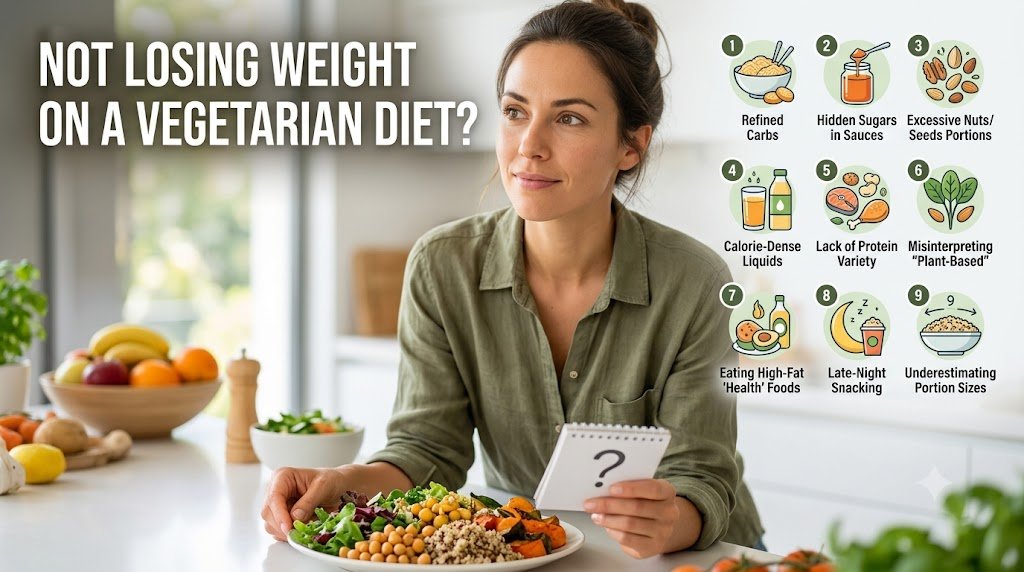
This article breaks down the nine hidden reasons you’re not losing weight on a vegetarian diet—and exactly what to do about each one. These aren’t theories. They’re the patterns I see over and over in real patients who are doing everything “right” but still stuck.
By the end, you’ll have a clear action plan to fix what’s broken and finally see the scale move.
Q: Why aren’t you losing weight on a vegetarian diet?
A: The most common reasons are hidden calorie sources—added oils, cheese, refined grains, and sugary drinks—plus inadequate protein intake and a lack of resistance training. Vegetarian diets work for weight loss when they’re built around whole plant foods. They fail when they become a collection of processed vegetarian products, calorie-dense oils, and refined carbohydrates. The fix is to prioritize protein at every meal, minimize added oils, choose whole grains over refined ones, and strength train 3–4 times per week.
9 Hidden Reasons You’re Not Losing Weight on a Vegetarian Diet
1 Your Protein Is Too Low
This is the single most common mistake I see. Most vegetarians dramatically underestimate how much protein they need—and how little they’re actually eating. A 2025 review found that vegans consume about 12.9% of calories from protein, compared to 16% for omnivores. A systematic review found that 27–41% of vegans fall below the recommended minimum intake.
Why does this matter for weight loss? Because protein preserves muscle during a caloric deficit. Lose muscle, and your resting metabolic rate drops. You burn fewer calories at rest. Weight loss stalls. And you feel weaker and hungrier.
Protein also has the highest thermic effect of any macronutrient—your body burns 20–30% of protein calories just digesting it. And it’s the most satiating macronutrient, keeping you full between meals.
✅ The fix:
- Aim for 1.2–2.0 g protein per kg body weight daily (84–140g for a 70 kg person)
- Spread protein across 3–4 meals, aiming for 25–35g per meal
- Prioritize: paneer, Greek yogurt, lentils, chickpeas, tofu, tempeh, edamame, hemp seeds
- Track your protein for one week to calibrate—most people are shocked by the gap
STOP GUESSING. START LOSING.
Get the high-protein vegetarian meal plan that takes the guesswork out of weight loss.
✅ 4-week structured plan | ✅ Macro tables | ✅ Real results
👉 GET THE PLANT-BASED MEAL PLAN 👈Trusted by thousands. Your future self will thank you.
2 Hidden Oils Are Sabotaging Your Deficit
This one catches almost everyone. You’re eating salads. You’re cooking vegetables. You’re doing everything right—except you’re pouring olive oil on everything. And oil is the most calorie-dense food in your kitchen.
One tablespoon of olive oil has 120 calories. A “generous drizzle” over a salad can easily be 2–3 tablespoons—240–360 calories. Sautéing vegetables? Another 2 tablespoons. That’s 600 extra calories before you’ve even plated your food. The JAMA Network Open study found that reducing oil intake contributed directly to weight loss on a vegan diet.
Oil isn’t “bad.” But it’s calorie-dense and easy to over-pour. When you’re trying to create a 500-calorie daily deficit, an extra 300 calories of oil can erase your entire week’s progress.
✅ The fix:
- Measure oil with a tablespoon—never free-pour
- Use a non-stick pan or parchment paper for roasting instead of oil
- Sauté with water, broth, or a splash of tamari instead of oil
- Use oil as a flavoring (a teaspoon for taste), not a cooking medium
- Try oil-free dressings: blended avocado, tahini thinned with lemon, or balsamic vinegar
3 You’re Eating Too Many Refined Carbs
White rice. White bread. White pasta. Instant oatmeal. Sugary cereals. These are all vegetarian—and they’re all working against you. Refined carbohydrates have had their fiber and nutrients stripped away. They digest quickly, spike blood sugar, and leave you hungry again within an hour or two.
Whole grains are a different story. Oats, brown rice, quinoa, barley, and whole wheat products retain their fiber, digest slowly, and keep you full. The fiber also feeds your gut bacteria, which produces short-chain fatty acids that support metabolic health.
The PDI (Plant-Based Diet Index) analysis specifically identified refined grains and sugary beverages as “unhealthful” plant foods associated with worse health outcomes. Even a vegan diet full of these foods can stall weight loss.
✅ The fix:
- Swap white rice for brown rice, quinoa, or barley
- Swap white bread for 100% whole wheat or sourdough
- Swap instant oats for steel-cut or rolled oats
- Read labels: “wheat flour” is refined; “whole wheat flour” is not
- Limit sugary cereals and pastries to occasional treats, not daily staples
🔥 Tired of guessing? Get the exact vegetarian meal plan that works.
Get the Plan →4 Liquid Calories Are Sneaking In
Smoothies. Fruit juice. Sweetened teas. Lattes. “Healthy” protein shakes loaded with sugar. Liquid calories are the ninja assassins of weight loss—they don’t trigger satiety the way solid food does, and they add up fast.
A large fruit smoothie can easily pack 400–600 calories. A glass of orange juice has 110 calories and almost no fiber. A sweetened iced tea can have 200+ calories. None of these make you feel full, so you eat the same amount of solid food afterward.
The PDI analysis identified fruit juice and sugar-sweetened beverages as “unhealthful” plant foods linked to worse weight outcomes. Even 100% fruit juice—while nutritious in small amounts—is a concentrated source of sugar without the fiber of whole fruit.
✅ The fix:
- Drink water, sparkling water, or unsweetened tea/coffee instead of juice and sweetened drinks
- Eat whole fruit instead of drinking fruit juice—the fiber slows sugar absorption
- If you love smoothies, make them a meal replacement with protein and veggies, not a snack
- Check protein shake labels—many “healthy” shakes have 20g+ of added sugar
5 Your Portions Are Bigger Than You Think
This is a tough one to hear, but it’s important: vegetarian food isn’t magically low-calorie. A cup of cooked lentils has about 230 calories. A cup of brown rice has 220. A cup of quinoa has 220. Add a generous pour of tahini dressing, a handful of nuts, and a sliced avocado—and your “healthy Buddha bowl” can easily hit 900–1,000 calories.
That’s fine if it’s your only big meal of the day. But if you’re eating three meals of that size plus snacks, you’re in a surplus—even though everything on your plate is “healthy.”
Calorie density matters. Vegetables and leafy greens are very low in calories. Legumes, whole grains, and starchy vegetables are moderate. Nuts, seeds, oils, cheese, and dried fruit are high. The ratio on your plate determines whether you’re in a deficit or a surplus.
✅ The fix:
- Fill half your plate with non-starchy vegetables first
- Use a food scale for one week to recalibrate your portion awareness
- Measure calorie-dense toppings (nuts, seeds, cheese, avocado, oil)
- Eat slowly—satiety signals take 15–20 minutes to reach your brain
- Don’t drink your calories while eating—it delays fullness signals
6 You’re Not Strength Training
Diet determines whether you lose weight. Strength training determines what kind of weight you lose. Without resistance training, a significant portion of your weight loss can come from muscle—especially if your protein intake is low.
The Stanford twin study found that vegan participants lost weight effectively but had more difficulty gaining lean muscle mass compared to omnivores, largely due to lower protein intake. This is the central trade-off of plant-based weight loss: it’s excellent for fat loss, but requires deliberate planning for muscle preservation.
Muscle is metabolically active. It burns calories even at rest. Lose muscle, and your daily calorie burn drops. That’s why people who lose weight without strength training often regain it—their metabolism has slowed, and they need fewer calories to maintain their new weight.
✅ The fix:
- Strength train 3–4 times per week—compound lifts (squats, deadlifts, push-ups, rows) are most efficient
- Progressive overload: gradually increase weight or reps over time
- Eat protein within 2 hours of training to support muscle repair
- Don’t rely on cardio alone—it burns calories but doesn’t preserve muscle
- Even bodyweight training at home works if you’re consistent and progress
7 Your Gut Health Is Working Against You
The gut microbiome plays a surprising role in weight regulation. A healthy gut with diverse beneficial bacteria supports better digestion, reduced inflammation, and improved satiety signaling. An unhealthy gut—often from a diet high in processed foods and low in fiber—can promote inflammation and insulin resistance.
The good news: a well-constructed vegetarian diet is one of the best ways to feed beneficial gut bacteria. Fiber from vegetables, legumes, and whole grains is fermented by gut bacteria into short-chain fatty acids like butyrate, which support metabolic health and reduce inflammation.
The bad news: if your vegetarian diet is high in refined carbs, oils, and processed foods, your gut bacteria suffer—and weight loss becomes harder.
✅ The fix:
- Eat 30+ different plant foods per week—diversity feeds diverse bacteria
- Include fermented foods: plain yogurt, kefir, tempeh, kimchi, sauerkraut
- Prioritize fiber from whole plant foods, not supplements
- Limit artificial sweeteners and processed foods that disrupt gut bacteria
YOUR METABOLISM NEEDS THE RIGHT FUEL
Get the high-protein vegetarian plan designed for fat loss and muscle preservation.
✅ Easy recipes | ✅ Calorie & macro breakdowns | ✅ 4-week structure
👉 DOWNLOAD THE MEAL PLAN NOW 👈Instant access. Start seeing results this week.
8 Sleep and Stress Are Blocking Fat Loss
You can eat perfectly and still stall if you’re sleeping five hours a night and running on cortisol. Chronic stress and sleep deprivation elevate cortisol, which promotes fat storage—especially around the abdomen—and increases appetite for high-calorie foods.
Sleep deprivation also reduces insulin sensitivity, making your body less efficient at using glucose for energy and more likely to store it as fat. And it disrupts leptin and ghrelin—the hormones that regulate hunger and fullness—making you hungrier and less satisfied after meals.
Most people trying to lose weight focus exclusively on diet and exercise. But sleep and stress management are equally important. You can’t out-diet a sleep deficit.
✅ The fix:
- Aim for 7–9 hours of quality sleep per night
- Keep a consistent sleep schedule—same bedtime and wake time daily
- Limit screens 1 hour before bed; blue light suppresses melatonin
- Manage stress with walking, meditation, deep breathing, or yoga
- Don’t rely on caffeine to mask fatigue—it worsens sleep quality
9 You Have an Underlying Medical Issue
Sometimes the problem isn’t your diet at all. Certain medical conditions can make weight loss extremely difficult, even when you’re doing everything right.
Hypothyroidism slows metabolism and causes fatigue, making it harder to burn calories and stay active. PCOS (polycystic ovary syndrome) affects insulin sensitivity and hormone balance, promoting fat storage—especially around the abdomen. Insulin resistance and prediabetes make it harder for your body to use glucose for energy, favoring fat storage. Medication side effects—from antidepressants, steroids, or beta-blockers—can also promote weight gain or block loss.
If you’ve been consistent with a well-constructed vegetarian diet for 6–8 weeks with no results, it’s worth talking to your doctor about testing thyroid function, fasting glucose, insulin, and relevant hormones.
✅ The fix:
- Ask your doctor for a full thyroid panel (TSH, Free T3, Free T4)
- Check fasting glucose, HbA1c, and fasting insulin for insulin resistance
- Review all medications and supplements with your doctor for weight-related side effects
- If you have PCOS, work with a dietitian who understands low-glycemic vegetarian eating
💪 Ready to fix these 9 issues in one structured plan?
Get the Vegetarian Weight Loss Plan →Frequently Asked Questions
Why am I gaining weight on a vegetarian diet?
Weight gain on a vegetarian diet usually comes from hidden calorie sources: added oils, cheese, refined grains, sugary beverages, and processed vegetarian foods. A vegetarian diet is only effective for weight loss when it’s built around whole plant foods—vegetables, legumes, whole grains, and adequate protein. The label “vegetarian” doesn’t guarantee a calorie deficit.
How long should it take to see weight loss on a vegetarian diet?
Most people see initial weight loss within 1–2 weeks—often from water and glycogen shifts. Meaningful fat loss (1–2 pounds per week) typically begins within 3–4 weeks of consistent adherence. If you’ve been consistent for 6–8 weeks with no change, review the nine reasons above and consider medical testing.
Is a vegetarian diet better than a non-vegetarian diet for weight loss?
Research suggests vegetarian and vegan diets often produce greater weight loss than omnivorous diets, primarily due to lower energy density and higher fiber intake. However, individual results depend on food quality and overall calorie intake. A poorly constructed vegetarian diet can be just as calorie-dense as a meat-based one.
How much protein do I need on a vegetarian weight loss diet?
For weight loss with muscle preservation, research supports 1.2–2.0 grams of protein per kilogram of body weight. A 70 kg person should target 84–140 grams daily. Spread intake across 3–4 meals for optimal muscle protein synthesis and satiety.
Can I lose weight on a vegetarian diet without exercise?
Yes, you can lose weight through diet alone. However, without resistance training, a significant portion of your weight loss may come from muscle rather than fat. This slows your metabolism and makes long-term maintenance harder. Strength training 3–4 times per week preserves lean mass and supports a healthier metabolism.
What are the biggest mistakes vegetarians make when trying to lose weight?
The biggest mistakes are: (1) not eating enough protein, (2) overusing calorie-dense oils, (3) relying on refined carbohydrates, (4) drinking liquid calories, (5) not strength training, (6) ignoring sleep and stress, and (7) not addressing underlying medical issues. Fixing these seven issues resolves the vast majority of weight loss stalls.
Do I need supplements on a vegetarian weight loss diet?
Vitamin B12 is essential for all vegetarians—it’s absent from plant foods and deficiency can cause serious neurological damage. Other nutrients to monitor include iron, zinc, omega-3 fatty acids (algae oil), and vitamin D. Creatine supplementation may also benefit vegetarians since dietary creatine comes primarily from meat.
Final Thoughts
If you’re not losing weight on a vegetarian diet, the problem isn’t vegetarianism. The problem is one or more of these nine hidden issues—most of which are fixable within weeks.
Start with protein. That’s the lever with the biggest impact. Then audit your oils, refined carbs, and liquid calories. Add strength training. Address sleep and stress. And if you’ve done everything right and still stuck, get tested.
The vegetarian advantage for weight loss is real—but it’s conditional. Build your diet around whole plant foods, prioritize protein, and train with resistance. The scale will move.
Your next meal is an opportunity. Make it work for you.
GET THE COMPLETE PLAN — START TODAY
Everything you need: high-protein vegetarian meals, macro tables, and a 4-week structure.
👉 GET INSTANT ACCESS NOW 👈Your transformation starts with one click. Don’t wait.
Disclosure & Disclaimer
Disclosure: This article contains affiliate links. If you purchase through these links, we may earn a commission at no additional cost to you. This helps support the creation of evidence-based content.
Disclaimer: This article is for informational purposes only and does not constitute medical advice. The information provided is not a substitute for professional medical advice, diagnosis, or treatment. Always seek the guidance of your physician or qualified health provider with any questions regarding a medical condition or dietary changes. Individual results vary. Weight loss outcomes depend on multiple factors including adherence, genetics, activity level, and overall health status. Dr. Mohammed Abdul Azeem Siddiqui has been in clinical practice for 30 years. Neither the author nor reviewer has any financial relationship with the affiliate products beyond potential commission from purchases.
P.S. If you’ve been stuck for weeks, don’t blame yourself—and don’t give up on vegetarian eating. The nine reasons in this article cover 95% of the stalls I see in clinical practice. Pick one fix and apply it this week. Then add another. Small, consistent changes beat perfection every time.
P.P.S. If you want a shortcut, the 4-week high-protein vegetarian meal plan takes the guesswork out of everything we covered here—protein targets, calorie control, and meal structure. You can check it out here.