
Ready to Transform Your PCOS Journey?
Thousands of women are finally seeing real results with GLP-1 medications. Don’t wait another day to discover which GLP-1 is right for you.
👉 Get Personalized Guidance Now ✓ Free consultation available • Trusted by thousands of womenIf you’re living with PCOS, you’ve likely heard the same advice repeatedly: “Just diet and exercise.” But if you’ve tried and struggled, you know it’s not that simple. The hormonal and metabolic dysfunction of PCOS can make weight loss 2 to 3 times slower than in women without the condition, even with identical calorie deficits. So when GLP-1 medications enter the conversation, the question becomes: does GLP-1 actually work better than diet and exercise for PCOS?
The short answer is nuanced: GLP-1 medications often produce faster and more significant results, but they are not a replacement for lifestyle changes—they are a powerful complement to them.
Why Diet and Exercise Alone Often Fail in PCOS
PCOS is not simply a lifestyle disease—it’s an endocrine disorder. Up to 80% of women with PCOS have some degree of insulin resistance, meaning their cells don’t respond properly to insulin signals. This triggers a cascade of metabolic dysfunction:
- The pancreas produces more insulin, leading to high insulin levels that signal the body to store fat, especially around the abdomen.
- Increased hunger and cravings make dietary compliance significantly harder.
- Hormonal imbalances (elevated androgens) actively work against weight loss efforts.
Weight loss is the backbone of patient management in women with obesity and PCOS, and is associated with improvement in cardiovascular risk, menstrual cycles, ovulation, and pregnancy rates. Lifestyle modifications are often the first-line intervention. However, the hormonal environment works against weight loss, and traditional diet and exercise approaches often fail because they don’t address the underlying metabolic dysfunction.
What GLP-1 Medications Do Differently
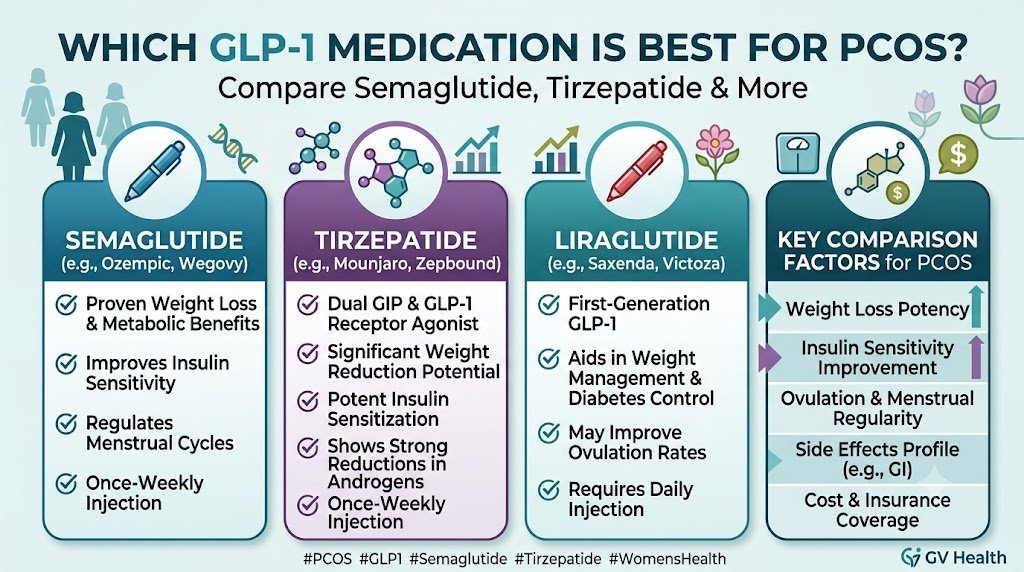
GLP-1 receptor agonists (like semaglutide, tirzepatide, and liraglutide) work through multiple mechanisms that directly counter the metabolic challenges of PCOS:
- Reduce appetite by acting on brain receptors
- Slow gastric emptying to keep you full longer
- Improve insulin secretion in response to meals
- Lower fasting insulin levels by 20-30% in PCOS patients
- Decrease liver fat content
What the Research Shows: GLP-1 vs Lifestyle Interventions
A 2025 comprehensive review published in Current Obesity Reports systematically compared various weight loss strategies in PCOS and found that outcomes depend on the specific PCOS phenotype:
| PCOS Phenotype | Most Effective Strategies |
|---|---|
| Hyperandrogenic type | Ketogenic diet, bariatric surgery — superior to GLP-1 + metformin, HIIT, and time-restricted eating |
| Reproductive dysfunction type | Ketogenic diet, bariatric surgery, GLP-1 + metformin — all superior to HIIT and time-restricted eating |
| Metabolic dysfunction type | Ketogenic diet, bariatric surgery, GLP-1 + metformin, HIIT, time-restricted eating — all showed benefit |
A 2026 meta-analysis of 18 randomized controlled trials found that GLP-1 receptor agonists produced a statistically significant reduction in BMI compared to control interventions. In subgroup analyses:
- Liraglutide vs metformin: BMI reduction of -1.30 kg/m² (p=0.02)
- GLP-1 vs placebo: BMI reduction of -2.08 kg/m² (p<0.00001)
- GLP-1 monotherapy vs GLP-1 + metformin: -1.39 kg/m² reduction (p<0.00001)
The meta-analysis also demonstrated a statistically significant reduction in insulin resistance (HOMA-IR) favouring GLP-1 receptor agonists compared with control interventions.
Beyond the Scale: Hormonal and Reproductive Benefits
GLP-1 medications have shown benefits beyond weight loss in PCOS patients:
- Improved menstrual regularity and restoration of ovulation
- Reduced ovarian cyst size
- Lower testosterone levels and improved lipid profiles
- Improved fertility outcomes after reaching weight loss goals
Important Note: GLP-1s do not directly treat elevated androgen levels — they improve the metabolic environment that exacerbates hyperandrogenism. A Cleveland Clinic review notes that while GLP-1s significantly reduce fasting insulin and insulin resistance, other variables measured were unchanged, including total and free testosterone and sex hormone-binding globulin. This suggests that PCOS is an intrinsic ovarian hyperandrogenism syndrome that is exacerbated by insulin resistance and metabolic syndrome, so weight loss alone may not restore the whole pathology in PCOS.
Your PCOS Breakthrough Starts Here
Stop guessing whether GLP-1 or lifestyle changes are right for you. Get connected with certified healthcare providers who specialize in PCOS.
🚀 Start Your Transformation Today ✓ Fast-track consultation • Personalized treatment plansThe Reality: GLP-1 Is a Tool, Not a Replacement
Several key points emerge from the evidence:
GLP-1 Does Not Replace Lifestyle Changes
GLP-1 medications are best understood as one tool in a broader treatment plan rather than a standalone solution. They do not replace nutrition, exercise, or sleep, which all play important roles in managing PCOS.
For many people, the most effective PCOS plan combines GLP-1 support with lifestyle changes, nutrition guidance, and, when needed, medications such as birth control pills, spironolactone, or metformin.
GLP-1s Are Not a Cure
GLP-1 medications help with many metabolic symptoms, but they do not cure PCOS or directly treat elevated androgen levels. They are not fertility medications and do not replace hormonal treatments when those are needed.
Weight Rebound Is a Real Concern
Evidence from non-PCOS populations suggests that discontinuation of GLP-1s before or during early pregnancy has been associated with greater gestational weight gain and less favorable pregnancy-related metabolic outcomes. While this hasn’t been definitively established in PCOS-specific studies, it remains a clinically plausible concern.
Lifestyle Is Still the Foundation
Healthy lifestyle behaviors encompassing healthy eating and physical activity should be recommended in all women with PCOS to optimize general health, quality of life, body composition, and weight. The Endocrine Society and other international societies recommend that healthy lifestyle behaviors be prioritized for all adolescents with PCOS.
When GLP-1 May Be the Better Choice
GLP-1 medications may be particularly beneficial for women with PCOS who:
- Experience persistent insulin resistance despite lifestyle efforts
- Have significant difficulty losing weight with diet and exercise alone
- Struggle with strong cravings tied to metabolic imbalance
- Have tried lifestyle modifications and other medications without meaningful improvement
- Have a BMI ≥ 35 kg/m² (severe obesity)
- Have PCOS with obesity and want to improve menstrual cycles, ovulation, and pregnancy rates
📌 The Bottom Line
GLP-1 medications often produce faster and more significant weight loss and metabolic improvements than diet and exercise alone in women with PCOS. However, they are not a replacement for lifestyle changes — they are a powerful complement.
The most effective approach is typically combination therapy: using GLP-1 to address the metabolic dysfunction that makes weight loss so difficult, while simultaneously implementing sustainable lifestyle changes that support long-term health.
A 2026 Chinese clinical consensus recommends that for overweight/obese PCOS patients, GLP-1 receptor agonists should be added on top of lifestyle intervention — not instead of it.
💡 “The question isn’t whether GLP-1 works better than diet and exercise. The question is: how can you use all available tools — GLP-1, nutrition, physical activity, and other therapies — to create the most effective PCOS management plan for your unique body?”
Final Takeaway
GLP-1 medications outperform diet and exercise alone for many women with PCOS, particularly those with significant insulin resistance or obesity. However, lifestyle changes remain the foundation of PCOS management. GLP-1 is a powerful tool that can make those lifestyle changes more effective — not a replacement for them.
If you’ve tried lifestyle modifications without the results you hoped for, GLP-1 may be the missing piece in your PCOS management plan. But the most sustainable approach is one that combines medication, nutrition, physical activity, and ongoing medical support.
Have you tried both lifestyle changes and GLP-1 for PCOS? What was your experience? Share in the comments below!
Disclosure: This article contains affiliate links. If you click through and make a purchase or sign up for services, we may receive a commission at no extra cost to you. We only recommend products and services we believe can provide value to our readers.
Disclaimer: This article is for informational purposes only and does not constitute medical advice. GLP-1 medications are prescription drugs that should only be used under the supervision of a qualified healthcare provider. PCOS management requires individualized treatment plans. Always consult with your physician before starting any new medication, supplement, or treatment protocol. Results vary based on individual health status and adherence to treatment plans.
PS: Your journey with PCOS is unique, and finding the right treatment approach could be the missing piece in your health puzzle. Connect with experts today who understand PCOS and can help you navigate your treatment options. Thousands of women have transformed their lives with the right combination of medication and lifestyle support — you could be next.