
If you’ve been following the health and wellness space lately, you’ve likely heard the buzz around a new class of medications that are changing lives. Names like Ozempic, Wegovy, Mounjaro, and Zepbound have become part of everyday conversation, often surrounded by incredible transformation stories. But with so many options, how do you know which one might be right for you?
Navigating the world of weight loss injectables can be confusing. Are they the same? Which one is the most effective? What are the real-world results? We’re breaking down the science, the numbers, and the practical differences between these four game-changing medications in a simple, head-to-head comparison. Understanding the “Ozempic vs Wegovy vs Mounjaro vs Zepbound for weight loss” debate is the first step toward making an empowered choice for your health.
👉 Learn More About Your Options 🔍 Compare plans
The Two Main Players: Semaglutide vs. Tirzepatide
To understand the differences, we first need to look at the active ingredients. The four drugs break down into two categories.
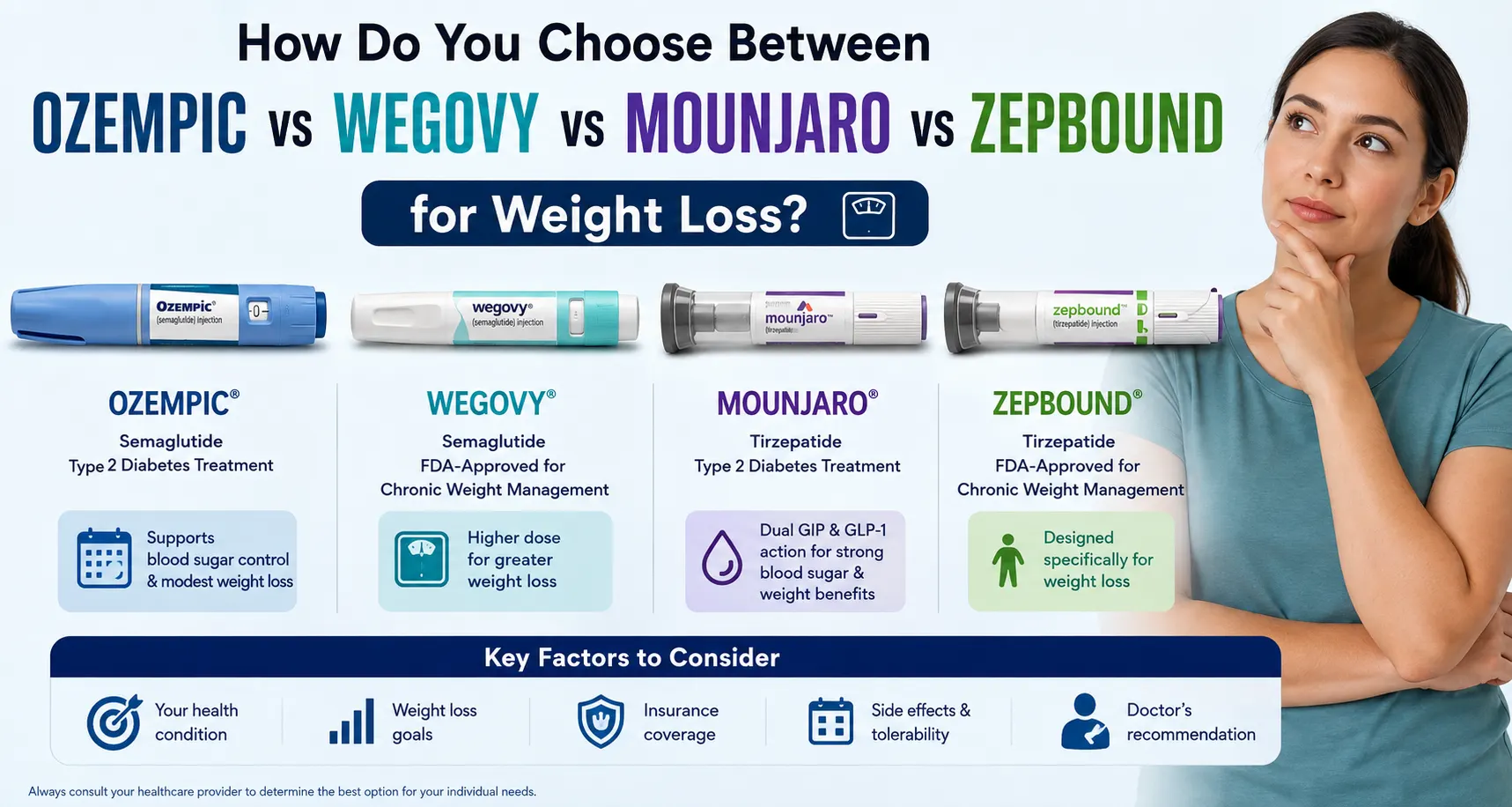
Semaglutide is the active ingredient in Ozempic and Wegovy (as well as the pill Rybelsus). It is a GLP-1 receptor agonist. In simple terms, it mimics a natural hormone in your body that helps control blood sugar and signals to your brain that you are full, reducing your appetite and “food noise”.
Tirzepatide is the active ingredient in Mounjaro and Zepbound. This is where things get interesting. Tirzepatide is a dual agonist, meaning it targets both the GLP-1 and GIP (glucose-dependent insulinotropic polypeptide) receptors. By mimicking two hormones instead of one, its effects on appetite suppression and metabolism are amplified.
The Key Differences: Indications and Dosing
The primary distinction often comes down to FDA approval for specific uses.
- Ozempic is specifically approved to manage type 2 diabetes. While it leads to weight loss, it is not FDA-approved for that purpose alone (though it is often prescribed “off-label” for weight loss).
- Wegovy is the exact same drug (semaglutide) but is FDA-approved for weight management. It is prescribed at a higher maximum dose (2.4 mg) than Ozempic (2.0 mg) for chronic weight management in adults with obesity or overweight with a weight-related condition.
- Mounjaro is approved for type 2 diabetes management.
- Zepbound is the same drug as Mounjaro (tirzepatide) but is FDA-approved specifically for weight loss and for treating moderate-to-severe obstructive sleep apnea in adults with obesity.
Semaglutide · T2D · max 2.0 mg
Semaglutide · weight loss · max 2.4 mg
Tirzepatide · T2D · dual agonist
Tirzepatide · weight loss · OSA
The Numbers Don’t Lie: Which is Most Effective for Weight Loss?
This is the million-dollar question. The data is clear: Tirzepatide (Zepbound/Mounjaro) is currently the most effective option for weight loss.
A landmark clinical trial called SURMOUNT-5 compared Zepbound and Wegovy head-to-head in people with obesity (without diabetes). The results were striking.
- Patients on Zepbound lost an average of 20.2% of their body weight (about 50 lbs).
- Patients on Wegovy lost an average of 13.7% of their body weight (about 33 lbs).
This means Zepbound provided 47% greater relative weight loss than Wegovy. In the real world, patients taking tirzepatide lost about 14.7% of their body weight compared to 10.8% for semaglutide. Whether you look at clinical trials or real-world data, the pattern is the same: tirzepatide is the new heavyweight champion in the “Ozempic vs Wegovy vs Mounjaro vs Zepbound for weight loss” comparison.
📲 Discover the Best Support Options 📋 Check availability
Side Effects and Tolerability
It’s important to note that both classes of drugs are generally safe and have been studied for decades. GLP-1 medications have been used to treat diabetes for 20 years. The most common side effects are gastrointestinal issues like nausea, vomiting, and constipation, which often subside over time as your body adjusts.
Interestingly, some studies suggest that tirzepatide may have a slightly better side effect profile. In one real-world analysis, patients taking tirzepatide reported fewer gastrointestinal and other adverse events than those on semaglutide. However, a meta-analysis found that while the drugs are comparable in risk, the need for dose escalation is key to improving tolerability.
Cost and Accessibility
Cost is a major factor. Out-of-pocket, these medications can be very expensive, with list prices often exceeding $1,000 a month.
- Wegovy has a list price around $1,349, but manufacturer savings cards can bring costs down to as low as $25 for commercially insured patients.
- Ozempic costs roughly $968 per month, but insurance is more likely to cover it if you have type 2 diabetes.
- Zepbound also offers a manufacturer savings card, potentially bringing the cost to $25 per month for those with insurance.
Insurance coverage remains a patchwork. Many plans are starting to cover these medications for weight loss, but it’s often a fight. Wegovy and Zepbound are more likely to be covered for weight loss than Ozempic and Mounjaro, which are diabetes drugs.
Making the Right Decision
So, when it comes to Ozempic vs Wegovy vs Mounjaro vs Zepbound for weight loss, here is the bottom line:
- If you want the absolute best results on the scale right now, the evidence points to Zepbound. Its dual mechanism appears to offer a superior weight loss advantage over semaglutide-based drugs.
- If cost or insurance coverage is a primary concern, Wegovy is an excellent and highly effective second choice, with strong data showing it helps people shed more than 12% of their body weight.
- If you have type 2 diabetes, your doctor will likely look at Ozempic or Mounjaro first, as they are specifically indicated for blood sugar control, with the added benefit of weight loss.
📌 Disclosure: This article contains affiliate links. We may receive a commission if you click on a link and make a purchase, at no extra cost to you. This helps support our work in bringing you high-quality content. All opinions expressed are based on the available scientific evidence at the time of writing.
© 2026 · Evidence-based comparison · updated for the latest clinical data