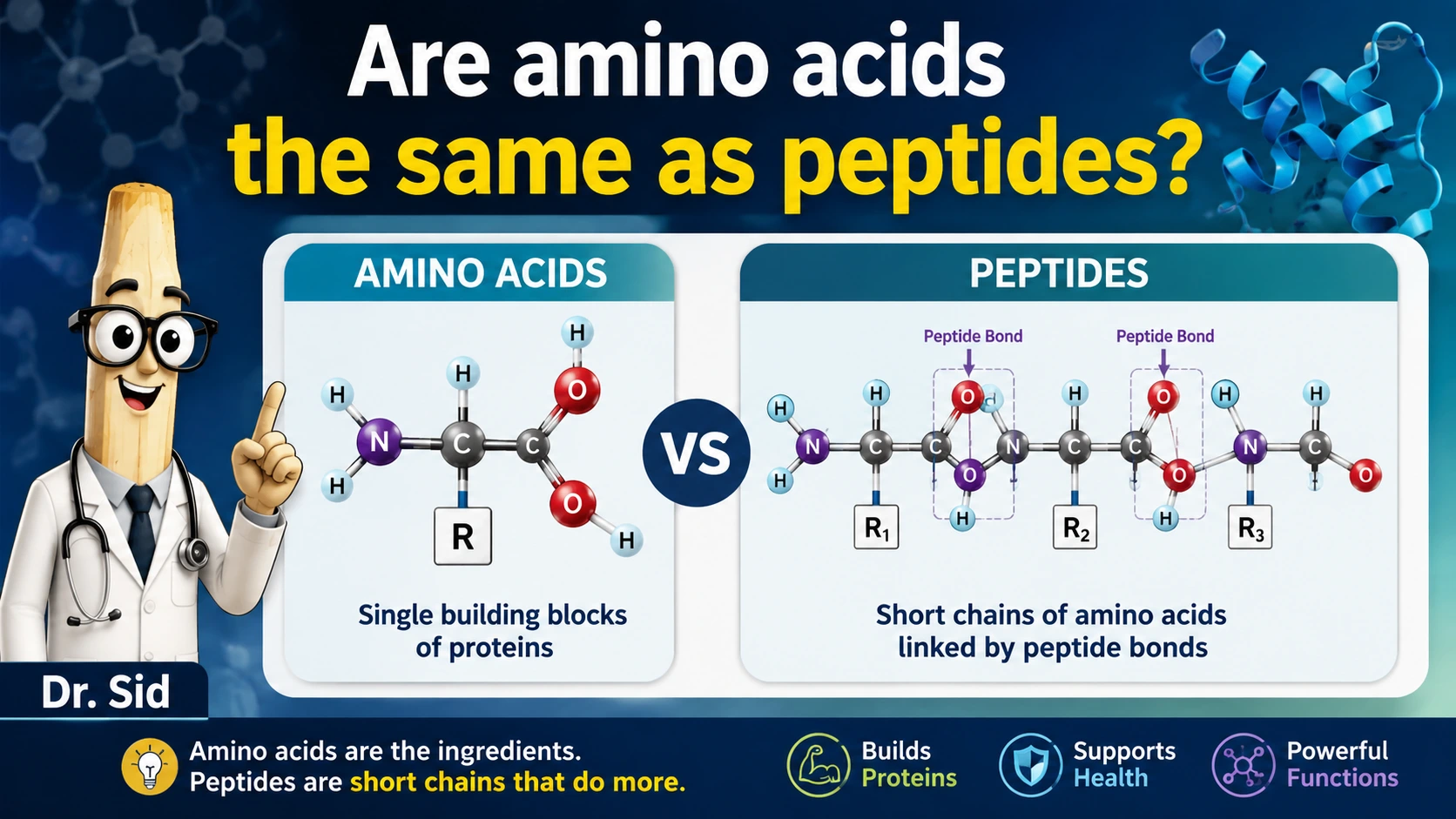

No, amino acids and peptides are not the same. Amino acids are individual, single molecules — the fundamental “building blocks.” Peptides are short chains formed when two or more amino acids link together via peptide bonds. Think of it like this: amino acids are individual LEGO bricks, and peptides are the small structures you build by snapping those bricks together. If you keep adding more bricks to create a very large and complex structure, you get a protein.
If you’ve ever looked at a nutrition label or read about skincare ingredients, you’ve likely encountered the terms “amino acids” and “peptides.” Often used interchangeably, they represent different things. Understanding the distinction is key to grasping how our bodies function at a fundamental level.
The difference: a single unit vs. a chain
The core difference lies in size and complexity.
1. Amino acids — the monomers
An amino acid is a single, small organic molecule. Its general structure contains a central carbon atom bonded to an amino group, a carboxyl group, a hydrogen atom, and a unique side chain (the “R” group) that determines its specific identity and properties. There are 20 standard amino acids that serve as the basic building blocks for all the proteins and peptides in our bodies.
2. Peptides — the polymers
A peptide is formed when two or more amino acids are linked together by a covalent bond known as a peptide bond. This bond forms between the carboxyl group of one amino acid and the amino group of another, releasing a molecule of water in the process.
The number of amino acids in the chain determines the classification:
| Term | Number of amino acids | Definition |
|---|---|---|
| Amino acid | 1 | A single molecule; the fundamental unit. |
| Peptide | 2 to ~50 | A short chain of amino acids linked by peptide bonds. A chain of two is a dipeptide, three is a tripeptide, etc. |
| Protein | ~50 or more | A large, complex molecule composed of one or more long polypeptide chains folded into a specific three‑dimensional structure. |
What is a peptide bond?
The peptide bond is the crucial chemical connection that turns individual amino acids into a peptide. It is a specific type of amide bond formed via a condensation reaction between two amino acids. This bond is very stable and gives the peptide chain its backbone structure, which is written from the free amino end (N‑terminus) to the free carboxyl end (C‑terminus).
🔗 In short: amino acids → peptide bond → peptides → longer chains → proteins.
FAQ — frequently asked questions
No. Amino acids are the individual units, while peptides are chains of those units linked together.
Not necessarily. They serve different purposes in the body. Amino acids are used to build new proteins and are essential for many metabolic processes. Peptides, because of their specific sequences, often function as signaling molecules, hormones, or antimicrobial agents. Some supplements, like collagen peptides, are broken down into smaller peptides and amino acids for absorption.
Yes, but the distinction is somewhat arbitrary. A peptide chain that becomes long enough (generally over 50 amino acids) is often called a polypeptide. When this chain folds into a specific, complex 3D structure and performs a biological function, it is classified as a protein.
Amino acids are linked together by peptide bonds to form peptides. The peptide bond is formed between the carboxyl group of one amino acid and the amino group of another.
Yes. Both peptides and proteins are polymers built from the same monomer units: amino acids. The primary difference is the size and complexity of the final structure.
The information provided in this article is for educational and informational purposes only and does not constitute medical advice. It is not intended to diagnose, treat, cure, or prevent any disease. Always consult with a qualified healthcare professional before starting any new dietary supplement, exercise regimen, or making any changes to your health routine.
© 2026 · clear guide · amino acids vs peptides